func New
New creates a new Memoizer instance.
Package memo provides a simple memoization utility to cache function results.
gno.land/p/moul/memo/v0A simple memoization utility to cache function results, backed by a B+ tree
(gno.land/p/nt/bptree).
A B+ tree packs many entries per persisted node, so it costs materially less storage and gas per cached entry than an AVL backing would.
 1import "gno.land/p/moul/memo/v0"
 2
 3m := memo.New()
 4
 5// Cache expensive computation; subsequent calls with the same key
 6// return the cached result without re-running the function.
 7result := m.Memoize("key", func() any {
 8	return "computed-value"
 9})
10
11m.Invalidate("key") // drop one entry
12m.Clear()           // drop all entries
13m.Size()            // number of cached entries
⚠️ Gno usage: storage updates only persist during transactions. Memoizing during queries/render will not persist and only wastes resources — use this in transaction-driven contexts.
Caveats from the B+ tree backing: it mutates in place (a copy-on-write AVL
backing would not), so do not Invalidate/add entries from inside a callback
iterating the same Memoizer, and do not copy a non-zero Memoizer by value.
Part of moul/gno-contracts — moul's versioned gno.land contracts. See the repository for the full catalog, build/test tooling, and usage.
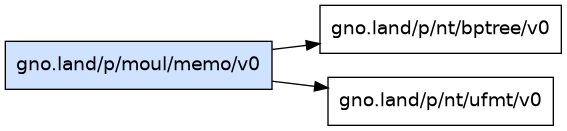
Dependency graph:
⚠️ Disclaimer: provided as-is, without warranty; not security-audited. Full disclaimer: DISCLAIMER.
Package memo provides a simple memoization utility to cache function results.
The package offers a Memoizer type that can cache function results based on keys, with optional validation of cached values. This is useful for expensive computations that need to be cached and potentially invalidated based on custom conditions.
It is the B+ tree successor to gno.land/p/moul/memo/v0 (which is backed by an AVL tree): a bump to v3 because the backing data structure — and thus the on-chain storage layout — changed. The exported API is identical to v2 (New/Memoize/MemoizeWithValidator/Invalidate/Clear/Size). A B+ tree packs many entries per persisted node, so it costs materially less storage and gas per cached entry — prefer v3 when the cache is part of persisted realm state.
Because the B+ tree backing mutates in place (the AVL backing was copy-on-write), do NOT invalidate or add entries to the same Memoizer from inside a callback that is iterating it, and do NOT copy a non-zero Memoizer by value.
/!\ Important Warning for Gno Usage: In Gno, storage updates only persist during transactions. This means:
Best Practices: - Use this pattern in transaction-driven contexts rather than query/render scenarios - Consider controlled cache updates, e.g., by specific accounts (like oracles) - Ideal for cases where cache updates happen every N blocks or on specific events - Carefully evaluate if caching will actually improve performance in your use case
Basic usage example:
 1m := memo.New()
 2
 3// Cache expensive computation
 4result := m.Memoize("key", func() any {
 5    // expensive operation
 6    return "computed-value"
 7})
 8
 9// Subsequent calls with same key return cached result
10result = m.Memoize("key", func() any {
11    // function won't be called, cached value is returned
12    return "computed-value"
13})
Example with validation:
 1type TimestampedValue struct {
 2    Value     string
 3    Timestamp time.Time
 4}
 5
 6m := memo.New()
 7
 8// Cache value with timestamp
 9result := m.MemoizeWithValidator(
10    "key",
11    func() any {
12        return TimestampedValue{
13            Value:     "data",
14            Timestamp: time.Now(),
15        }
16    },
17    func(cached any) bool {
18        // Validate that the cached value is not older than 1 hour
19        if tv, ok := cached.(TimestampedValue); ok {
20            return time.Since(tv.Timestamp) < time.Hour
21        }
22        return false
23    },
24)
Memoizer is a structure to handle memoization of function results.
Clear clears all cached values.
Invalidate removes the cached value for the specified key.
Memoize ensures the result of the given function is cached for the specified key.
MemoizeWithValidator ensures the result is cached and valid according to the validator function.
Size returns the number of items currently in the cache.